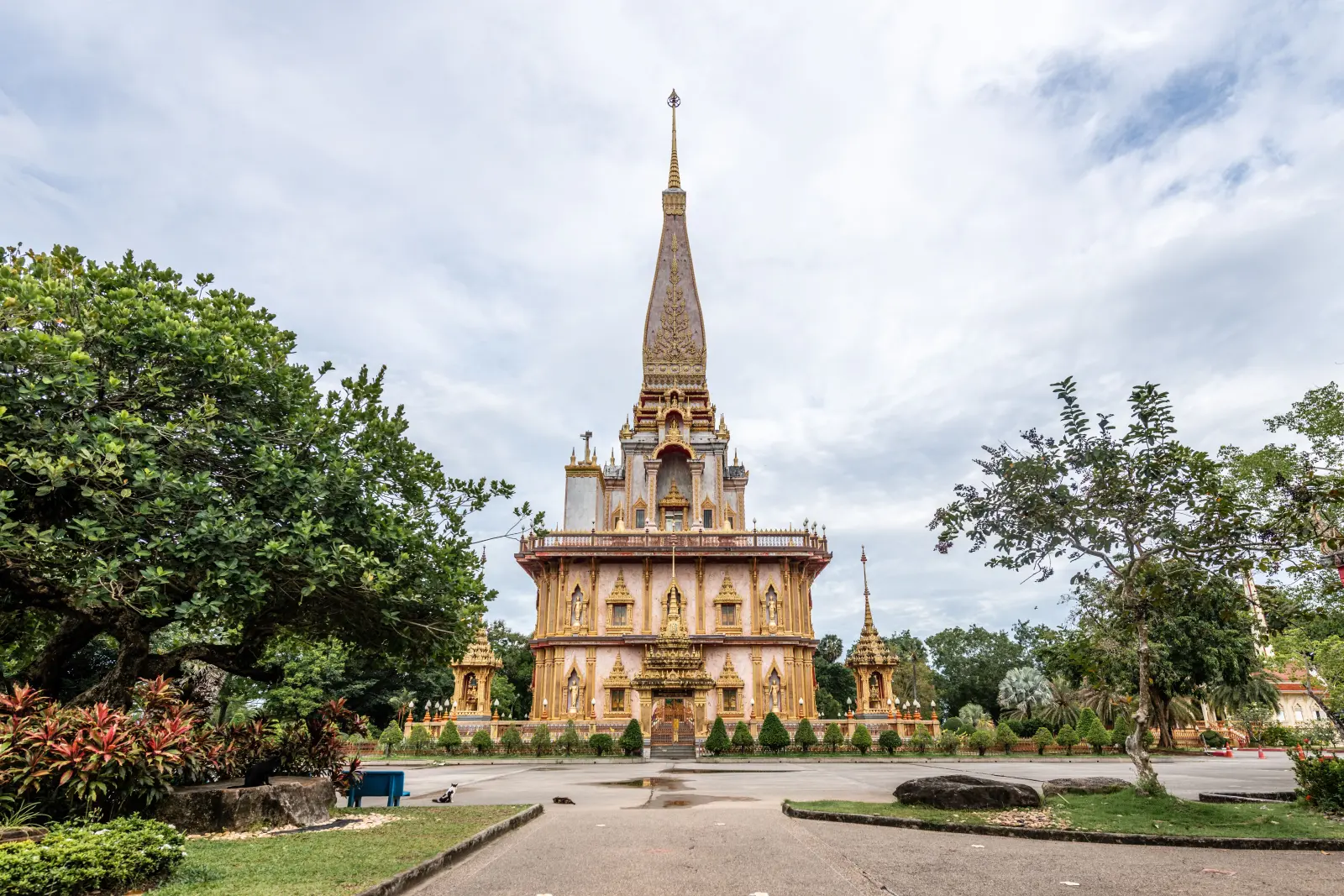
Wat Chalong (officially Wat Chaiyathararam) is Phuket's largest and most visited Buddhist temple, in Chalong, Mueang Phuket. It matters because of 1876, when its monks sheltered and treated people during the Chinese tin miners' rebellion, and because its 60-metre chedi holds a fragment of the Buddha's bone. Entry is free, it's open daily from about 07:00 to 17:00, and you should cover your shoulders and knees.
Wat Chalong at a glance
The 1876 rebellion and the monks who stayed
In the 19th century Phuket was a tin-mining island, and many of the miners were Chinese migrant workers organised in secret societies. In 1876 unrest broke out and spread across the island, with serious loss of life. Villagers urged the abbot, Luang Pho Chaem, to flee. He refused to abandon his monastery.
Instead Wat Chalong became a sanctuary. Luang Pho Chaem and fellow monk Luang Pho Chuang took in people who needed help and used their knowledge of herbal medicine to treat the injured. By 1877 government forces had put down the rebellion. King Rama V appointed Luang Pho Chaem Chief Ecclesiastical Officer of Phuket and renamed the temple Wat Chaiyathararam. Islanders have credited his protection ever since.
Luang Pho Chaem and Luang Pho Chuang
Lifelike wax statues of both monks, covered in gold leaf left by generations of worshippers, sit in the temple's halls. Luang Pho Chaem (1827 to 1908) became abbot in 1850 and remains the most revered monk in Phuket. Visitors still come to pray to him.
The Phra Mahathat Chedi and the Buddha relic
The 60-metre golden chedi was built between 1991 and 2001. Its three levels hold Buddha images and murals, and the top floor shows a fragment of the Buddha's bone. Sri Lanka gave the relic to King Rama IX in 1999. The terrace gives a view across the temple grounds.
The explosions: gratitude, protection and two traditions
Near the main buildings stands a brick kiln-like structure where firecrackers go off through the day. At Wat Chalong the custom is gratitude. Devotees buy firecrackers from a vendor, an attendant lights them, and the blast says thank you for a wish or prayer that has been answered. Big firecrackers are for big answered prayers.
The noise also carries Chinese tradition. In Chinese culture, firecrackers (baozhu, "exploding bamboo") scare away evil spirits, and the legend of the monster Nian says loud noise drives away what threatens the village. Phuket's Chinese community brings the same custom to festivals such as the Vegetarian Festival, so the crackle at Wat Chalong reflects a blend of Thai Buddhist and Chinese traditions.
Our reading, not a documented meaning: on an island that held off a siege in 1785 and sheltered its people in 1876, a loud, shared, public noise can feel like a community's courage and thanks as much as a celebration.
The kiln can be loud and sudden. It's visible from the walkways, so you don't need to stand beside it. Take ear protection for children and never put your head near the kiln.
Phuket's other defence story: the heroines of 1785
Phuket's second famous defence is older. In 1785, during the Nine Armies' War, a Burmese army besieged Thalang, then the island's main town, just as the governor had died. Sisters Lady Chan and Lady Mook organised the defence, and women dressed as soldiers to make the garrison look larger. After about a month the Burmese withdrew, on 13 March. King Rama I honoured the sisters as Thao Thep Kasattri and Thao Sri Sunthon. Their monument stands on Thepkasattri Road in Thalang, and a festival marks the victory each year from 13 to 15 March.
Wat Chalong and Phuket timeline
What Phuket's history shows
- Community defence works: In 1785 and 1876, ordinary people and monks, not only soldiers, held the island together.
- Care in conflict matters: Wat Chalong is remembered for sheltering and healing, not only for the fighting.
- Cleverness can beat force: The 1785 defenders won by looking stronger than they were.
- Memory needs places and rituals: Monuments, statues, temple fairs and festivals keep these stories alive.
- Phuket blends cultures: Thai and Chinese traditions share the temple, the festivals and the island. See the Phuket Vegetarian Festival for another example.
How to visit Wat Chalong
- Hours and cost: Daily, about 07:00 to 17:00, free (donations welcome).
- Dress code: Cover shoulders and knees, with no sleeveless tops or short shorts. Take shoes off before entering buildings.
- Best time: Early morning, 07:00 to 09:00, for fewer crowds and monks' morning rituals.
- Time needed: 1 to 2 hours. Climb the chedi to the top for the view.
- Firecrackers: Devotees set off firecrackers in a brick structure to give thanks when a prayer is answered. Expect noise.
- Temple fair: A fair runs around Chinese New Year.
- Parking: Free. Big Buddha is about 8 km away.
Fit it into a Phuket trip
Wat Chalong is in south Phuket, so it pairs easily with the southern hotels in our where to stay guide. Plan a temple morning on one day and a boat day on another. Our Phi Phi & Bamboo Island tour picks up from your hotel between 08:15 and 09:15. Our Thai guides also care about this history; see why guests choose our Thai crew and our guide to responsible travel in Thailand. Visiting in October? See the best time to visit.